


The Complete Guide to Brake Fluid in Singapore (2026): Safety, Performance & Humidity
- Darren Phang
- 1 day ago
- 13 min read

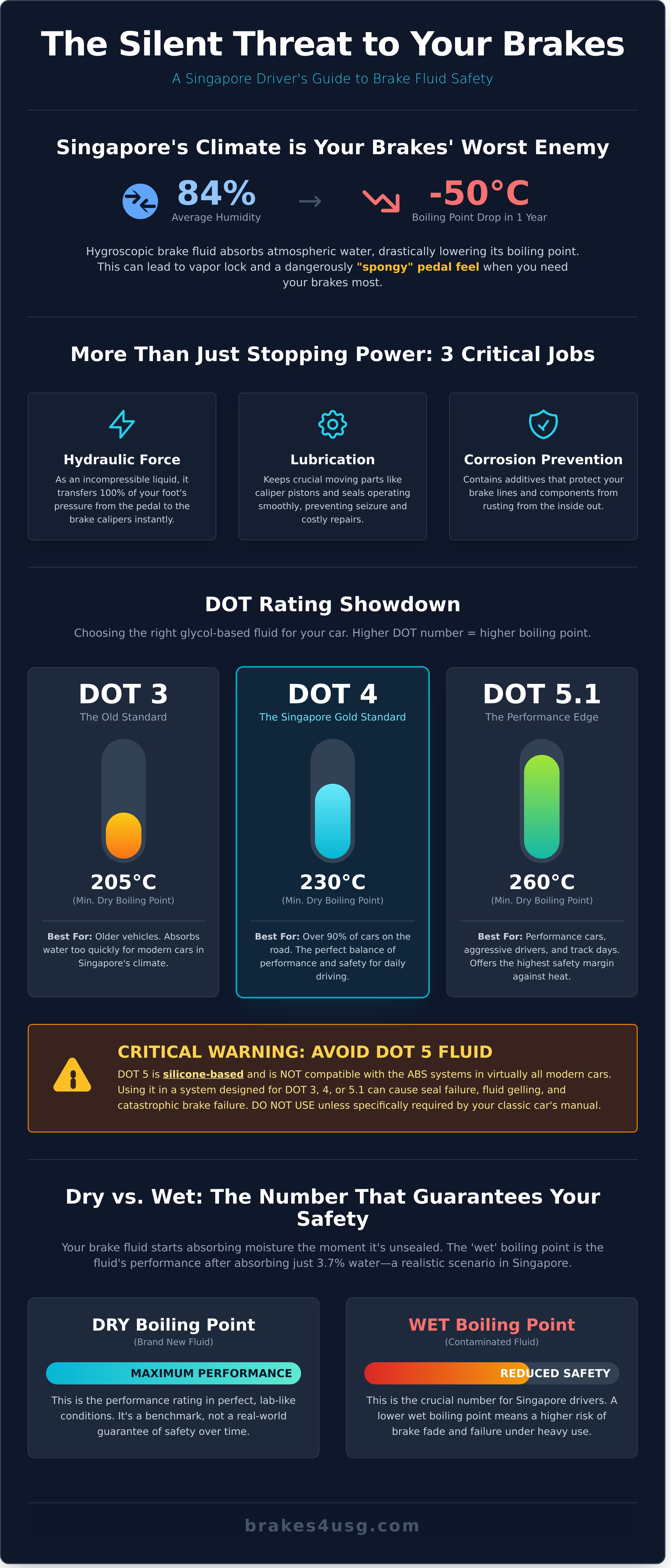
Did you know that in Singapore's 84% average humidity, your brake fluid can absorb enough water to lower its boiling point by over 50°C in just one year? You worry about your brake pads. You listen for that squeal. But the silent threat to your stopping power is the one thing most drivers forget.
That spongy pedal feel isn't normal; it's a warning sign. This guide cuts through the noise. We'll give you the straight facts on DOT 3 vs. DOT 4, show you exactly how our climate tries to ruin your brakes, and give you the confidence to choose the right fluid for your car. We cover everything from the daily drive to the track day, ensuring you get maximum safety without overspending.
Key Takeaways
Discover why Singapore’s high humidity is the biggest enemy of your brakes and how to fight back.
Choose the right brake fluid for your car by understanding the simple difference between DOT 3, 4, and 5.1.
Learn if upgrading to high-performance fluid is the key to unlocking better stopping power in heavy traffic.
Recognise the warning signs of old fluid and know exactly when a professional flush is critical for your safety.
Table of Contents What is Brake Fluid and Why is it Critical for Singapore Drivers? Understanding DOT Ratings: DOT 3, 4, and 5.1 Explained The Performance Edge: Racing Brake Fluid vs. Standard Street Fluid Brake Fluid Maintenance in Singapore: Dealing with Tropical Humidity Professional Brake Fluid Flush & Performance Upgrades at Brakes4uSG
What is Brake Fluid and Why is it Critical for Singapore Drivers?
Your car’s ability to stop doesn’t come from the brake pedal. It comes from brake fluid. This is the single most important fluid for your safety on the road. It’s a specialised, non-compressible hydraulic liquid that takes the force from your foot and multiplies it, creating the immense pressure needed to clamp the brake pads and stop your vehicle. Without it, your brake pedal is useless.
In Singapore, this isn't just a maintenance item. It's a critical safety component. Driving through CBD gridlock or crawling along the PIE during peak hour places extreme demands on your braking system. The constant starting and stopping generates incredible heat and pressure. Your brake fluid has to perform perfectly every single time, whether you're tapping the brakes at an ERP gantry or making a full-force emergency stop on the AYE.
Beyond creating pressure, the fluid also serves two other key jobs:
It lubricates moving parts. Components like pistons and seals inside the calipers need constant lubrication to move freely. Old, dirty fluid causes wear and leads to expensive repairs.
It prevents corrosion. Brake fluid contains additives that stop moisture from rusting your brake lines and components from the inside out. This is a major issue in Singapore's 80% average humidity.
Bottom line: without clean, fresh fluid, your car cannot generate the hydraulic force required to stop safely. Your pedal might feel soft, or worse, go straight to the floor in an emergency. It’s a risk you can’t afford to take.
The Science of Incompressibility
Why a liquid? Because liquids don't squash under pressure. When you hit the brakes, the fluid transfers 100% of that force instantly. Air, on the other hand, compresses easily. If air bubbles get into your brake lines, pressing the pedal just squeezes the air instead of activating the brakes. That’s the dangerous "spongy pedal" feeling. It means you're losing stopping power, and it needs immediate attention.
Brake Fluid vs. Other Car Fluids
Never substitute another fluid for brake fluid. Ever. Engine oil, power steering fluid, and transmission fluid are designed for completely different jobs and will destroy your brake system's seals, leading to total brake failure. The technical answer to What is Brake Fluid? lies in its chemical makeup. Most cars in Singapore use a glycol-ether base (DOT 3, 4, or 5.1), while some European brands like Citroën may use a specific mineral oil. Using the wrong type is as bad as using no fluid at all.
Understanding DOT Ratings: DOT 3, 4, and 5.1 Explained
The numbers on a bottle of brake fluid aren't for show. They're a rating system set by the Department of Transportation (DOT) that tells you exactly how the fluid will perform under heat and stress. These ratings, defined in the official Federal Motor Vehicle Safety Standards, are based on the fluid’s boiling point and chemical base. Getting it wrong is not an option. Your ability to stop depends on it.
Here’s the simple breakdown for Singapore drivers:
DOT 3: The old standard. It's a glycol-based fluid with a minimum dry boiling point of 205°C. You'll find it in older cars, but it’s not tough enough for modern vehicles or Singapore's start-stop traffic. It absorbs water too quickly.
DOT 4: The Singapore gold standard. This is the right choice for over 90% of Japanese and European cars on our roads. With a higher minimum dry boiling point of 230°C, it handles the heat from heavy braking much better. It's the practical, safe choice for daily driving.
DOT 5.1: High-performance fluid. Also glycol-based, but engineered for extreme heat with a minimum dry boiling point of 260°C. If you drive aggressively, own a performance car, or do track days at Sepang, this is your fluid. It offers the highest safety margin against brake fade.
DOT 5: The outsider. This is critical: DOT 5 is silicone-based. It does not absorb water and is NOT compatible with the anti-lock braking systems (ABS) found in almost every modern car. Using it in a system designed for DOT 3, 4, or 5.1 can cause catastrophic brake failure. Avoid it completely unless your classic car's manual specifically demands it.
Dry vs. Wet Boiling Points
Every bottle of brake fluid lists two temperatures. The "dry" boiling point is the fluid's performance when it's brand new and perfectly sealed. The "wet" boiling point is its performance after it has absorbed 3.7% water. In Singapore’s 80%+ average humidity, your fluid starts absorbing moisture from the air immediately. That's why the wet boiling point is the only number that guarantees your safety year-round.
Mixing Different DOT Fluids
Don't play chemist with your brakes. Mixing different fluids is a bad idea. Never mix silicone-based DOT 5 with any glycol-based fluid (3, 4, or 5.1). It will turn into a thick gel, clog your brake lines, and lead to a massive repair bill. While you can technically top up a DOT 3 system with DOT 4 fluid, you immediately lower the performance of the new fluid. It's a temporary fix that compromises safety. Our advice is simple: don't mix. A complete brake fluid flush from a specialist is the only guaranteed way to ensure your system is clean, safe, and filled with 100% fresh fluid.
The Performance Edge: Racing Brake Fluid vs. Standard Street Fluid
Your daily drive on the PIE is not a race track. Standard DOT 4 brake fluid is made for that reality. It's designed to last up to two years, safely absorbing moisture from Singapore’s humid air without a fuss. It works perfectly for 99% of cars on the road.
Racing brake fluid is different. It’s not built for long life. It’s built for one thing: extreme heat resistance. High-performance brands like Brembo and AP Racing create fluids that far exceed standard DOT 4 specifications. They sacrifice long-term moisture absorption for the highest possible boiling point right now. For a track day, "right now" is all that matters.
If you're planning a trip to Sepang International Circuit, your factory-fill fluid is a liability. The long straights followed by heavy braking into Turn 1 and Turn 9 generate massive, sustained heat. This heat will overwhelm a standard fluid. Upgrading your brake fluid isn't a suggestion; it's a critical safety requirement before your first lap.
Vapor Lock: The Track Driver’s Nightmare
Here’s the hard truth about track driving. Brakes get hot. Very hot. If your fluid has absorbed even a small amount of water, that heat can turn it into steam. Water boils at 100°C; a top-tier racing fluid boils at over 300°C. When steam forms in your brake lines, you get a bubble. Unlike fluid, steam compresses. You press the brake pedal, the bubble squishes, and nothing happens. The pedal sinks to the floor. This is vapor lock. It’s total brake failure.
High-performance calipers, like those in a Brembo GT big brake kit, generate incredible stopping force. That force creates even more heat. While the calipers are designed to manage it, they put immense stress on the fluid. This is why racing fluids need to be changed so often. They are highly hygroscopic, meaning they absorb moisture faster than street fluids. Proper brake fluid maintenance for a track car often means flushing the system after just a few track days, or every 3-6 months, to ensure zero moisture content.
Top Performance Fluids at Brakes4uSG
We stock only the best because your safety depends on it. These fluids are engineered for the specific demands of high-heat braking, giving you a firm, reliable pedal lap after lap.
Brembo LCF 600 Plus: A top choice for drivers who use their car on both the street and the track. With a dry boiling point of 316°C, it offers a huge safety margin over standard fluids. Its low compressibility gives you a firm and consistent pedal feel, which is crucial for precise braking.
Endless RF-650: This is the gold standard. Used in Formula 1, WRC, and Dakar Rally cars, its 323°C dry boiling point is among the highest available. It's the ultimate choice for dedicated track cars and endurance racing, offering unmatched performance and reliability under the most severe conditions.
AP Racing Radi-CAL R4: Engineered for the absolute limit. With a dry boiling point of 340°C, the R4 is designed for the most demanding big brake kit applications, from professional motorsports to extreme track day cars. If you're running a top-tier braking system, this is the fluid you need to unlock its full potential.
Brake Fluid Maintenance in Singapore: Dealing with Tropical Humidity
Singapore’s climate is your brake system’s worst enemy. With average relative humidity consistently above 80%, your car is bathing in moisture 24/7. This is a serious problem because your brake fluid is hygroscopic. That’s a technical term for a simple fact: it actively absorbs water straight from the air.
This moisture seeps in through microscopic pores in your rubber brake hoses over time. It’s a slow, silent process you won't notice until it's too late. Once water contaminates the system, two dangerous things happen. First, it drastically lowers the fluid's boiling point. Second, it starts to rust your brake components from the inside out, attacking calipers and master cylinders.
This pervasive humidity doesn't just threaten vehicles; it's also a primary cause of household issues like mould growth. Understanding how to manage moisture is key, and for those interested in professional solutions for their property, you can find out more.
Your regular LTA inspection checks for obvious leaks and basic brake function. They don't hook up a machine to test the moisture content of your fluid. You can pass your inspection with a perfect record and still be driving with fluid that’s over 3% water, putting you squarely in the danger zone.
The 2-Year Rule vs. The Singapore Reality
Most manufacturers recommend a fluid change every two years. For a car parked outdoors in Singapore, that might be pushing it. The constant humidity accelerates moisture absorption. Don't rely on the calendar alone. Your car will give you warning signs that your fluid is contaminated:
Spongy Pedal: The brake pedal feels soft or sinks further than usual.
Dark Fluid: Fresh fluid is clear or light amber. Old, wet fluid looks dark and murky.
Longer Stops: You have to press harder and it takes longer to stop your car.
At Brakes4uSG, we eliminate the guesswork. We use a professional digital moisture tester to check your fluid’s exact water percentage in under 60 seconds. You see the results yourself. No opinions, just data.
The Cost of Neglect
Ignoring your brake fluid isn’t saving you money. It’s setting you up for a massive repair bill. That water-logged fluid corrodes expensive parts. A seized ABS pump can cost over S$1,500 to replace. Ruined Brembo or AP Racing calipers? Even more. This damage happens silently, until a critical part fails completely.
The safety risk is even greater. During a hard stop on the PIE, your brakes generate extreme heat. Fresh DOT 4 fluid boils at over 230°C. Fluid with just 3.7% water can boil at 155°C. When it boils, it creates steam bubbles. You can compress steam, but you can't compress fluid. The result is total brake failure. Your pedal goes straight to the floor, precisely when you need it most.
Preventive maintenance is the cheapest insurance you can buy. A complete brake fluid flush costs a tiny fraction of a single major component replacement. Don't guess about your safety. Get a free, no-obligation brake fluid moisture test at Brakes4uSG and know for sure.
Professional Brake Fluid Flush & Performance Upgrades at Brakes4uSG
Your car's stopping power is only as good as the fluid in its lines. Old, water-logged fluid is a safety risk on Singapore roads, leading to a soft pedal and longer stopping distances. At our dedicated Kaki Bukit workshop, we don't just change your fluid; we restore your braking system's performance and your confidence. We are Brakes4uSG, The Brake Specialists. We offer same-day service to get you back on the road safely and quickly. No fluff, just expert work.
Don't settle for a basic drain and fill from a general workshop. We use advanced, pressurized bleeding systems that force out every last drop of old, contaminated fluid and any trapped air bubbles. This is the only way to guarantee a firm, responsive pedal, especially for vehicles made after 2010 with complex ABS and traction control systems that can easily trap air.
Our service is built on two principles: expertise and speed.
Expert Consultation: Are you a daily driver or a track day enthusiast? We'll help you choose the perfect brake fluid for your exact needs. A Toyota Camry navigating the ECP has different requirements than a modified Subaru WRX needing high-temperature protection. We stock a full range, from reliable DOT 4 for daily use to high-performance DOT 5.1 and racing fluids from brands like Motul and Brembo.
Guaranteed Results: Our process ensures your system is 100% free of air and moisture. The result? An immediate, noticeable improvement in pedal feel and stopping performance. And we do it fast. Most flush services are completed in under 90 minutes, getting you back on the road with total peace of mind.
Our Precision Bleeding Process
The old method of "pumping the pedal" is obsolete and risky. It can't clear air trapped deep inside modern ABS modules, leading to a spongy, unsafe pedal. For high-performance big brake kits (BBKs), our pressure system is non-negotiable. It ensures every channel and piston is perfectly bled. We finish every job with a specialist road test to verify pedal feel and confirm your car stops exactly as it should. Your safety is guaranteed.
Complementary Brake Inspections
Every fluid service includes our signature Free Brake Inspection. We don't just look; we measure. We check brake pad thickness down to the millimeter, inspect rotors for scoring or heat spots, and examine brake lines for any signs of cracking or wear. We spot problems before they become a danger on the road. Ready for total braking confidence? Book your professional brake fluid flush at Brakes4uSG today!
Secure Your Stopping Power in Singapore
Your safety on Singapore's roads comes down to one thing: reliable brakes. We've shown how the island's constant 80%+ humidity attacks your system, turning clean brake fluid into a spongy, water-logged liability. Choosing the correct DOT 4 or 5.1 fluid isn't just for performance; it's a critical safety decision that prevents brake fade when you need it most. A regular fluid flush isn't an upsell. It's essential maintenance.
Don't guess if your brakes are safe. Know for sure. At Brakes4uSG, we provide honest, expert service without the dealership hassle. As Singapore’s official Brembo Upgrade Dealer and specialists in AP Racing and Endless systems, we handle everything from standard flushes to high-performance upgrades. Find us easily at Premier @ Kaki Bukit.
Your car is waiting. Your safety can't. Get a Professional Brake Inspection and Fluid Flush at Brakes4uSG today and drive with total peace of mind.
Frequently Asked Questions About Brake Fluid
How often should I change my brake fluid in Singapore?
You should change your brake fluid every 2 years or 40,000 km in Singapore. Our climate's high humidity, which averages 84%, causes fluid to absorb water much faster. This contamination dangerously lowers the boiling point and can lead to brake failure under pressure. A scheduled change is cheap insurance for your safety. Stop by for a free brake inspection; we can test your fluid's condition on the spot.
Can I use DOT 5.1 fluid in a car that requires DOT 4?
Yes, you can use DOT 5.1 fluid in a system that requires DOT 4. They are both glycol-based fluids and are fully compatible. Using DOT 5.1 is actually a performance upgrade because it has a higher boiling point. The critical rule is to never use DOT 5 fluid. It's silicone-based and will cause expensive damage to your brake system's seals. Stick to the right type to avoid repairs.
What are the symptoms of low or contaminated brake fluid?
The most common symptom is a soft or "spongy" brake pedal that sinks towards the floor. You might also see the red brake warning light on your dashboard or notice your car takes longer to stop than it used to. These are serious safety warnings that your fluid is either dangerously low or contaminated with water. Don't risk it. Get a free brake inspection immediately. We offer same-day service to get you back on the road safely.
Is it safe to drive with a "spongy" brake pedal?
No. It is extremely unsafe to drive with a spongy brake pedal. That feeling means there is air or moisture in your hydraulic system, which can compress under pressure. This leads to a severe loss of braking power, especially during an emergency stop. Your pedal could sink to the floor with no effect. Stop driving the car immediately and have it brought to a specialist. Your safety is not worth the gamble.
How much does a brake fluid change cost in Singapore?
A complete brake fluid flush and replacement in Singapore typically costs between S$60 and S$120. The final price depends on your car's make and the specific type of fluid it requires. At our workshop, we offer affordable, fixed-price services with no hidden fees. We believe in transparent pricing so you know exactly what you're paying for. Get a guaranteed, honest price when you book your service with The Brake Specialists.
Why is my brake fluid turning dark or black?
Your brake fluid turns dark because it's contaminated. Over time, it absorbs moisture from the air and collects tiny particles from degrading rubber hoses and seals. Fresh fluid is a clear, light amber color; dark or black fluid is a clear sign it's old and has lost its ability to protect your brake system from corrosion. It’s a visual warning that you need a fluid change now to prevent expensive damage.
Does brake fluid damage car paint?
Yes, absolutely. Glycol-based brake fluid like DOT 3 and DOT 4 is extremely corrosive to your car's paint. Even a small drop can soften and strip the paint right down to the bare metal if you don't act fast. If a spill happens, do not wipe it. Immediately flush the area with plenty of water to neutralize and wash it away completely. This is one reason why it’s best to let a professional handle the job.
Can I top up my brake fluid myself at home?
While you can technically top up the fluid, it's not a good idea. A low fluid level almost always points to a bigger problem: either your brake pads are worn out, or you have a dangerous leak in the system. Simply adding more fluid just masks the root cause and can lead to sudden brake failure. The safest and most affordable solution is a free brake inspection. We'll find the real problem and fix it right.
Comments