


How to Choose the Right Brake Kit for Your Car in Singapore (2026 Guide)

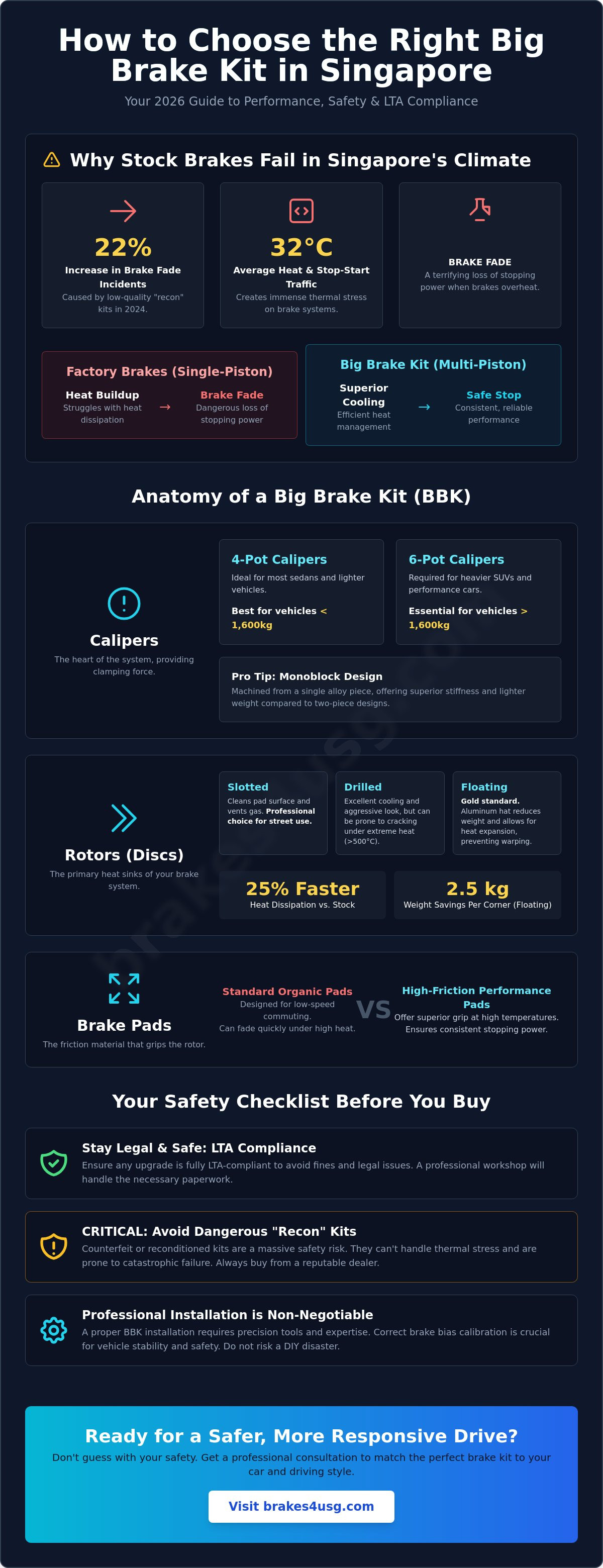
That "cheap" big brake kit you found on a marketplace could be the difference between a safe stop and a S$15,000 repair bill. In 2024, local workshops saw a 22% increase in brake fade incidents caused by low-quality "recon" kits. These parts can't handle Singapore's stop-start heat. You want shorter stopping distances and a firmer pedal feel. You don't want LTA fines or counterfeit parts failing at high speed. Learning how to choose the right brake kit is the only way to guarantee your car stays on the road. It keeps your budget intact.
We agree that safety shouldn't be a guessing game. You need a setup that handles the heat of a North-South Highway run. It must remain fully legal for your daily commute. This 2026 guide from the brake specialists simplifies the technical essentials. You get the best performance for your budget. We will break down the 4-pot versus 6-pot debate. We'll show you how to spot dangerous fakes. This is your clear roadmap for a fast, LTA-compliant upgrade.
Key Takeaways
Stop brake fade in Singapore’s heat. Learn why factory single-piston calipers struggle in stop-start traffic and how to fix it fast.
Get the facts on how to choose the right brake kit by matching 4-pot or 6-pot calipers to your specific vehicle weight.
Stay legal and safe on the road. Understand LTA compliance and why you must avoid dangerous "recon" kits at all costs.
Balance performance with daily comfort. Compare absolute stopping power against real-world trade-offs like brake dust and noise.
Don't risk a DIY disaster. Discover why professional installation and proper brake bias calibration are non-negotiable for your safety.
Table of Contents Understanding Brake Kits: Why Factory Brakes Often Fail in Singapore The Core Components: Deciphering Calipers, Rotors, and Pads Performance vs. Street: Matching the Kit to Your Driving Style The Selection Checklist: Fitment, LTA, and Avoiding "Recons" Professional Installation: Why Precision is Non-Negotiable
Understanding Brake Kits: Why Factory Brakes Often Fail in Singapore
Most cars sold in Singapore come equipped with standard hardware designed for average commutes. A brake kit is a coordinated system of calipers, rotors, and pads designed to replace this OEM hardware. It isn't just a cosmetic upgrade. It's a performance overhaul. Stock brakes usually feature single-piston sliding calipers. These are cheap to produce but struggle under pressure. In Singapore, our 32°C average heat and constant stop-start traffic on the PIE or CTE create massive thermal stress. Your brakes don't get enough "cool down" time between traffic lights. This leads to heat soak.
The "Brake Fade" problem is real for local drivers. When heat builds up, you experience a terrifying loss of stopping power. High humidity levels in Singapore also play a role. Humidity can lead to moisture absorption in brake fluid, which lowers its boiling point. Upgrading your system provides improved heat dissipation and a consistent pedal feel. You get significantly shorter stopping distances. Learning how to choose the right brake kit starts with knowing the limits of your current factory setup. We focus on getting you back on the road safely and affordably.
The Anatomy of a Big Brake Kit (BBK)
A BBK changes the fundamental disc brake components on your vehicle's hub. Fixed multi-piston calipers are the heart of the system. Unlike sliding designs, fixed calipers provide equal clamping force from both sides of the rotor. This results in more immediate response. Oversized rotors are another key feature. They increase the "leverage" against the spinning wheel. The larger surface area allows the system to shed heat 25% faster than standard discs. We pair these with high-friction pads. These pads move beyond the soft organic materials used in standard commuter cars, offering better grip at higher temperatures.
Is a BBK Necessary for Singapore Roads?
You need to assess your driving style before you buy. Daily commuting at 50km/h might not require a 6-piston setup. However, if you frequently take spirited North-South Highway drives or own a heavy SUV, stock brakes are likely underpowered. Heavier vehicles require much more force to stop, especially in emergency situations. A tuned sedan also demands more stopping power to match its increased speed.
Weight and power are the two biggest factors when deciding how to choose the right brake kit for your specific car. Don't forget the aesthetic factor. Many Singaporean car enthusiasts choose a BBK to enhance the visual appeal of their vehicle. Large, brightly colored calipers look impressive behind open-spoke alloy wheels. It's a functional upgrade that also adds significant resale value. We provide the expertise to help you pick the right size for your rim clearance without overspending on features you don't need.
The Core Components: Deciphering Calipers, Rotors, and Pads
Don't waste money on parts your car can't use. Learning how to choose the right brake kit means matching hardware to your vehicle weight and local driving habits. It's about physics, not just aesthetics. You need a system that handles Singapore's heat without breaking the bank.
Choosing the Right Caliper Design
Choosing the right caliper is a critical step when deciding how to choose the right brake kit. 4-pot calipers are sufficient for most Japanese and Korean sedans under 1,600kg. Heavier European SUVs or performance cars require 6-pot units to ensure even pressure across larger pads. Monoblock calipers are machined from a single piece of alloy. They offer superior stiffness and weight savings compared to bolted two-piece designs. If you are comparing Brembo and AP Racing, pay attention to piston sizing. Larger pistons aren't always better. If they don't match your master cylinder, you'll end up with a long, mushy pedal stroke that feels unresponsive.
Rotors: Slotted, Drilled, or Both?
Rotors are your primary heat sinks. High-carbon metallurgy is the standard for 2026 because it resists warping under heavy thermal loads. Drilled rotors provide excellent cooling and look aggressive, but they are prone to stress cracking if they exceed 500°C on a track. Slotted rotors are the professional choice for daily street use. They act like a squeegee, cleaning the pad surface and venting gases for a consistent bite. For high-end builds, floating rotors are the gold standard. They use an aluminum center "hat" to allow for heat expansion, which reduces distortion and cuts unsprung weight by up to 2.5kg per corner. This comprehensive guide to choosing a brake kit provides more detail on how rotor mass affects stopping distance.
Brake Pads for the Singapore Climate
Singapore's 84% average humidity and tropical heat demand specific pad compounds. Ceramic pads are popular because they stay quiet and keep your rims free of black dust. However, semi-metallic compounds like EBC Yellowstuff or Ferodo Racing offer better performance when pushed hard. You must check the operating temperature range. Avoid "racing-only" pads for city driving. These compounds often require temperatures above 250°C to function. On a cold morning or a wet PIE commute, they won't provide the immediate friction you need to stop safely.
Don't forget the hoses. Factory rubber lines expand when the fluid gets hot. This creates a "spongy" feel. Swapping to braided stainless steel hoses is an affordable way to ensure a firm, confidence-inspiring pedal. If you're overwhelmed by the technical specs, get a free brake inspection to see what your car actually needs.
Performance vs. Street: Matching the Kit to Your Driving Style
Don't waste money on parts you'll never use. Knowing how to choose the right brake kit starts with being honest about your driving. Are you navigating CBD traffic or hitting 200km/h at Sepang? Most Singaporean drivers want better safety and better looks. That's a street kit. Professional track kits are often a headache for daily use. They are loud. They eat through rotors. They require significant heat to actually stop the car. Understanding how to choose the right brake kit means balancing your budget with your actual needs. Before you spend a single S$1,000, consult LTA's guidelines on vehicle modifications. Staying legal is the first step to staying safe.
The trade-offs are simple. High-performance race pads offer absolute stopping power but come with annoying squeal and heavy black dust. Street kits prioritize comfort and cleanliness. Track pads are abrasive; they act like sandpaper on your rotors when they're cold. If you only drive to the office, you'll replace your expensive rotors twice as often for zero benefit. Finding the sweet spot involves selecting a kit that matches your car's weight and your typical speed.
The Daily Driver Upgrade
Street driving requires "cold bite." You need the car to stop instantly when a taxi swerves into your lane. You don't have time to warm up your rotors. We recommend the Brembo BM series or the AP Racing World Radi-CAL for these needs. These systems provide a 20% to 30% safety margin over stock parts. They offer quiet operation and low dust. You get the aggressive look of a performance caliper without the constant squealing at traffic lights. It's a direct upgrade that maintains your car's comfort while cutting down stopping distances significantly.
The Weekend Warrior & Track Enthusiast
Track use is a different beast. You need parts that can handle 20-minute sessions of hard deceleration. Standard brakes will overheat and fail within minutes at Sepang International Circuit. AP Racing Brakes are the preferred choice for local enthusiasts because they prioritize thermal management. These kits use advanced metallurgy to resist warping under high stress. You must also upgrade your fluid. Use a high-boiling point fluid to prevent brake fade. A dedicated track setup is an investment in your car's survival on the circuit, but it requires more frequent maintenance than a street kit.
Pure Street: Focus on low noise, low dust, and immediate response.
Hybrid: Use street-legal calipers with high-performance pads for occasional spirited driving.
Dedicated Circuit: Prioritize heat dissipation and use specialized racing fluids.
The Selection Checklist: Fitment, LTA, and Avoiding "Recons"
Buying a Big Brake Kit (BBK) isn't just about the aggressive looks. It's about stopping power you can trust when traffic hits the brakes on the PIE. Follow this checklist to understand how to choose the right brake kit without wasting money or failing your next inspection.
Step 1: Verify wheel clearance. Use a paper fitment template from the manufacturer. Wheel diameter alone is a lie; you need to know if the caliper body clears the back of your spokes.
Step 2: Check LTA compliance. The kit must be designed specifically for your vehicle make and model. Avoid "universal" brackets that require modification to your car's hub.
Step 3: Source from authorized dealers. Fakes are common in 2026. Genuine hardware comes with a unique serial number and a manufacturer warranty that protects your investment.
Step 4: Avoid the "Recon" trap. Refurbished or "reconditioned" calipers are often salvaged from scrap yards. They look new with a fresh coat of paint, but internal pistons and seals are often worn out. In a high-heat emergency stop, these seals can fail. It's not worth the S$500 savings.
Step 5: Plan for maintenance. Ensure your workshop offers professional installation and future services like disc skimming. Skimming removes surface irregularities and keeps your rotors smooth.
LTA Compliance and Legality in Singapore
Singapore has strict rules for a reason. Any brake modification must not compromise the vehicle's structural integrity. Your new kit must fit the original mounting points without custom welding or unsafe adaptors. Using replica brake kits is a guaranteed way to fail your VICOM or STA inspection. These fakes often crack under pressure. Keep every receipt and certificate of authenticity in your glovebox. If an LTA officer asks, you need proof that your kit is genuine and model-specific. Safety isn't a suggestion; it's the law.
Wheel Fitment and Clearance Issues
Many drivers think an 18-inch wheel automatically fits a 4-pot caliper. That's a mistake. The "X-Factor" refers to the distance between the wheel spokes and the caliper face. High-offset wheels often lack this space. You might consider spacers, but be careful. Spacers thicker than 5mm can change your car's handling and might lead to LTA trouble if the tires protrude past the fender. Always perform a physical test fit before you pay. It saves you the headache of buying a S$3,000 kit that won't clear your rims.
Don't risk your safety on guesswork.
Professional Installation: Why Precision is Non-Negotiable
Buying the hardware is only half the battle. You can spend S$4,000 on a top-tier Brembo or AP Racing kit, but a bad install makes it useless. DIY attempts or "neighborhood workshops" often lack the precision tools required for high-performance systems. If you are learning how to choose the right brake kit, you must prioritize the hands that fit it. One loose bolt or a misaligned bracket leads to catastrophic failure on the KPE or PIE. Mistakes here aren't just expensive; they're dangerous.
Calibrating brake bias is a technical necessity. Your car needs the front and rear systems to work in harmony. If the balance is off, your ABS might trigger too early or your car could dive nose-first during hard stops. We ensure the hydraulic pressure matches your car's weight distribution. Proper bedding-in, or burnishing, is also vital. This process transfers a thin layer of pad material onto the rotor surface. Without it, your new pads will glaze and your rotors will vibrate within weeks. We handle the burnishing so your car is ready for the road the moment you leave.
The Brakes4uSG Installation Process
We don't just "bolt on" parts. Our process is clinical. We focus on three critical areas to ensure your safety:
Precision mounting: We ensure the caliper is perfectly centered over the rotor. A 0.5mm offset causes uneven pad wear and reduces stopping power.
System bleeding: We remove every air bubble. We use premium high-boiling-point fluid to ensure a rock-solid pedal feel even under heavy heat.
Post-install inspection: Our technicians verify torque specs on every fastener. We check for wheel clearance under full steering lock and suspension load.
Maintenance: Keeping Your BBK in Peak Condition
High-performance brakes require regular eyes. Don't wait for a warning light. Check your pad thickness every 10,000km, or every 5,000km if you hit the track. You need to decide between car brake upgrades or simple disc skimming when performance dips. Skimming can remove surface imperfections and save you the cost of new rotors if the minimum thickness is still met. Monitoring your hardware prevents S$1,000 mistakes later. Knowing how to choose the right brake kit includes knowing how to keep it running.
Ready to upgrade? Don't leave your safety to chance. Visit Brakes4uSG for a professional brake inspection today. We are the brake specialists Singapore trusts for track-ready performance and daily reliability.
Get the Stopping Power Your Car Deserves
Stop wasting time with factory brakes that fail in Singapore's 32-degree humidity and constant stop-start traffic. You need gear that works every single time you hit the pedal. Understanding how to choose the right brake kit means prioritizing LTA compliance and genuine components over cheap "recon" parts that put your life at risk. At Brakes4uSG, we are an Official Brembo Upgrade Dealer and specialists in AP Racing and Alcon systems. Our dedicated Singapore workshop uses professional lathe services to ensure every rotor and caliper installation is flawless. We don't do fluff; we do precision stopping power. Whether you're navigating tight CBD streets or cruising the KPE, your safety shouldn't be a guessing game. Don't wait for a close call to realize your brakes are fading under pressure. Get the expert performance you need right now without the dealership price tag. Upgrade your stopping power with Brakes4uSG today and stay safe on the road.
Frequently Asked Questions
Is it legal to install a Big Brake Kit (BBK) in Singapore?
Yes, installing a Big Brake Kit is legal in Singapore if it complies with Land Transport Authority (LTA) standards. LTA regulations state that modifications must not compromise vehicle safety. You don't need a specific inspection for brake upgrades, but they must use proper mounting brackets. Our specialists ensure every installation meets these 2026 safety requirements. Get a free brake inspection to confirm your current setup is road legal.
Will a big brake kit fit under my stock wheels?
Most big brake kits won't fit under stock wheels without modifications. Original equipment wheels often lack the 20mm of lateral clearance required for larger multi-piston calipers. You might need wheel spacers or a complete rim upgrade to 18 inch or 19 inch sizes. We measure your wheel offset precisely to avoid rubbing. This is a vital step when learning how to choose the right brake kit for your specific car model.
What is the difference between a 4-pot and a 6-pot caliper?
The main difference is the number of pistons applying pressure to the brake pads. A 4-pot caliper uses four pistons, while a 6-pot uses six. 6-pot systems distribute clamping force more evenly across a larger pad surface area. This reduces taper wear and improves heat dissipation during heavy use. For daily driving in Singapore traffic, a 4-pot system is often the most affordable and effective upgrade.
Why are "recon" or refurbished brake kits considered dangerous?
Refurbished or "recon" kits are dangerous because their structural history is unknown. These parts often come from scrap yards or accident vehicles and may have invisible hairline cracks. Seals in used calipers often fail under high pressure, leading to total brake loss. We only install 100 percent new, guaranteed authentic kits. Saving a few hundred S$ isn't worth risking a 100km/h brake failure on the PIE.
Do I need to upgrade my rear brakes if I install a front BBK?
You don't always need to upgrade the rear brakes, but it helps maintain vehicle balance. Front brakes handle roughly 70 percent of the stopping force in most passenger cars. Installing a powerful front BBK without adjusting the rear can cause the nose to dive excessively. We recommend high performance rear pads to match your new front kit. This setup provides a stable, flat stopping experience without the high cost of a full rear conversion.
How long does it take to install a performance brake kit?
A professional installation typically takes 3 to 5 hours. We prioritize speed and offer same day service for most performance upgrades. This includes removing old components, fitting new rotors and calipers, and bleeding the brake lines. Our technicians work efficiently so you can get back on the road fast. Don't wait around all day at a generalist workshop when the brake specialists can do it quicker.
Does a big brake kit require more maintenance than stock brakes?
Yes, performance kits usually require more frequent inspections than stock systems. High friction pads often wear down 25 percent faster than standard ceramic pads. You should check your fluid levels and pad thickness every 10,000 kilometers. Understanding these maintenance intervals is part of how to choose the right brake kit for your lifestyle. We offer free brake inspections to keep your performance parts in top condition.
Can I use my stock brake master cylinder with a performance kit?
You can usually keep your stock master cylinder, but the pedal feel will change. Larger calipers require more fluid volume to move the pistons. This often results in 10 to 15 percent more pedal travel before the brakes bite. Most drivers adapt to this change within 2 days of driving. If the pedal feels too soft, we can suggest compatible master cylinder upgrades to restore a firm, immediate response.


Comments