


What is Brake Fade and How to Prevent It? (Singapore Driver’s Guide)

Last December, a driver named Tan discovered that his new brake pads weren't enough to stop his car from sliding toward a barrier on the North-South Highway. He pressed the pedal, but it felt like stepping on a wet sponge. This split second of panic is exactly why you need to understand what is brake fade and how to prevent it before your next drive. It happens when heat overwhelms your system, and it's a common risk during long descents or heavy traffic on the PIE.
You probably think your brakes are safe as long as the pads have meat on them. It's a common belief, but heat doesn't care about pad thickness. We'll help you master the science of consistent stopping power on Singapore roads and Malaysian highways. This guide explains the difference between pad and fluid fade, how to maintain your system to avoid failure, and whether a Brembo or AP Racing upgrade is a smart investment for your safety. Stop guessing and start driving with total confidence.
Key Takeaways
Learn exactly what is brake fade and how to prevent it to keep your stopping power consistent on SG roads and Malaysian highways.
Identify the three main types of fade to pinpoint issues fast and avoid overpaying for the wrong repairs.
Understand why Singapore’s high humidity is a silent killer for your brake fluid and how to stop sudden hydraulic failure.
Master simple maintenance habits that save you money while keeping your vehicle safe and road-legal.
Compare performance upgrades like Brembo and AP Racing kits to handle extreme heat better than standard factory setups.
Table of Contents What is Brake Fade? Understanding the Loss of Stopping Power The Three Main Types of Brake Fade Explained Why Singapore Drivers Face Unique Brake Fade Risks How to Prevent Brake Fade: Practical Tips for SG Owners Performance Upgrades: Stopping Fade with a Big Brake Kit
What is Brake Fade? Understanding the Loss of Stopping Power
Brake fade isn't a permanent mechanical failure. It's a temporary, dangerous reduction in your car's ability to stop. This happens when your braking system generates more heat than it can dissipate. When the friction surfaces of your pads and rotors get too hot, they lose the ability to convert kinetic energy into heat. Your car keeps moving even when you're pressing the pedal. Understanding what is brake fade and how to prevent it is vital for every driver in Singapore, especially when navigating heavy traffic or long descents.
Unlike a snapped cable or a broken caliper, fade often disappears once the system cools down. This makes it "invisible" during a standard drive home after the incident. However, the risk is immediate. If you're driving down a long slope like those near Mount Faber or handling high-speed runs on the PIE, a sudden loss of stopping power can lead to a serious accident. You need your brakes to work every single time you hit the pedal.
The Science of Friction and Heat
Braking relies on friction. When you press the pedal, your brake pads clamp onto the spinning rotors. This process turns your vehicle's forward movement into heat energy. Every brake system has a specific thermal limit based on the quality of the pads, the size of the rotors, and the type of fluid used. Most commuter cars are designed for city driving, not high-performance heat cycles. The kneepoint is the specific temperature threshold where the friction coefficient of the brake pad material drops sharply, leading to a sudden loss of stopping power. Once you pass this point, your brakes become significantly less effective regardless of how hard you push.
Signs You Are Experiencing Brake Fade
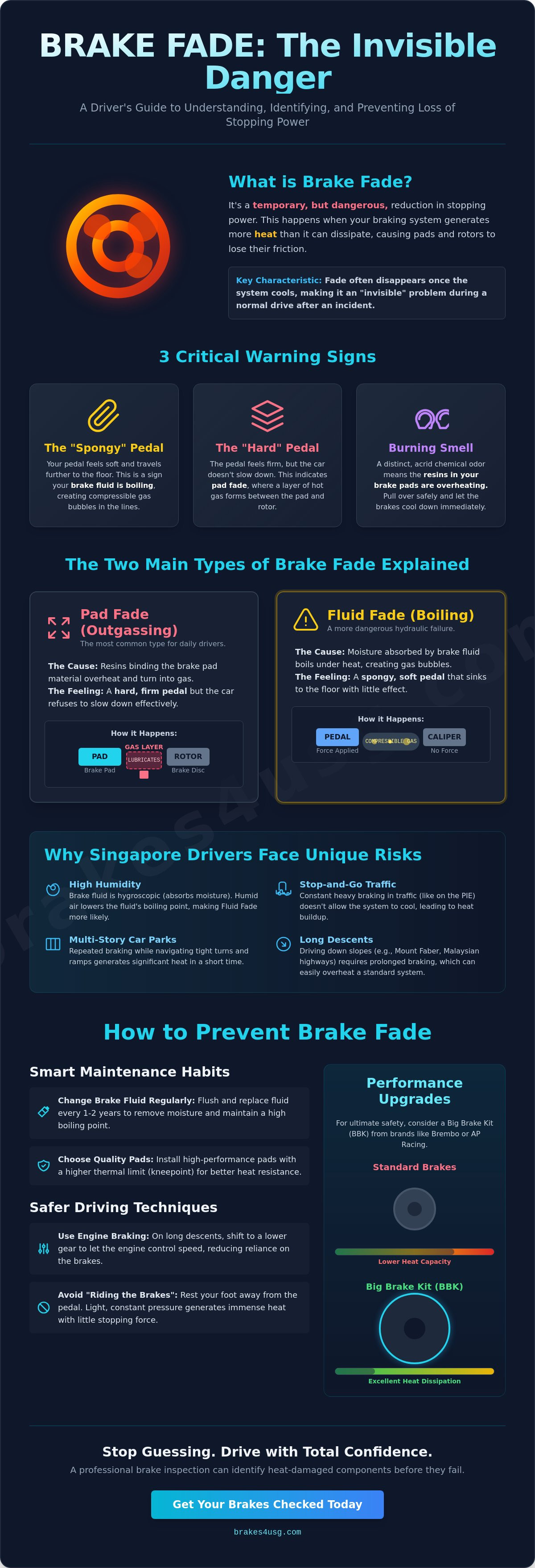
You don't need a mechanic to tell you when your brakes are failing. You'll feel it through your foot and smell it in the air. Pay attention to these three specific warning signs:
The "Spongy" Pedal: If the pedal feels soft or like you are stepping on a marshmallow, your brake fluid might be boiling. This creates gas bubbles in the lines which compress, unlike liquid fluid.
The "Hard" Pedal: The pedal stays firm, but the car refuses to slow down. This is friction fade. It happens when the pad material gets so hot it essentially "glazes" or creates a thin layer of gas between the pad and the rotor.
Burning Smell: You'll notice a distinct, acrid chemical odour. This is the smell of overheated resins in your brake pads. If you smell this, pull over immediately.
In the Singapore climate, humidity can also lower the boiling point of your brake fluid over time. This makes knowing what is brake fade? even more important for local car owners. Don't wait for a close call to check your system. Professional brake specialists can identify heat-damaged components during a quick inspection, potentially saving you from a S$2,000 repair bill or a major collision on the expressway.
The Three Main Types of Brake Fade Explained
Brake fade isn't just one single problem. It is a symptom of heat affecting different parts of your braking system. To understand what is brake fade and how to prevent it, you must first identify which component is failing. Not all fade feels the same. Some types make the pedal feel hard, while others make it go soft. Identifying the specific cause helps you find the right fix without wasting money on parts you don't need.
Drivers in Singapore often face these issues due to stop-start traffic on the PIE or heavy braking in multi-story car parks. Most experts categorize these failures into three distinct groups. Understanding the three main types of brake fade allows you to take the right corrective action before a minor heat issue turns into a total system failure.
Pad Fade and Outgassing
This is the most common type of fade for daily drivers. Brake pads use resins to bind the friction material together. When these pads exceed their temperature limit, the resins turn into gas. This process is called outgassing. The gas creates a thin, high-pressure layer between the pad and the rotor. It acts like a lubricant. You press the pedal, but the car refuses to slow down. This usually happens with stock pads that aren't rated for high performance. If you feel a firm pedal but zero stopping power, your pads are likely outgassing.
Fluid Fade: When Your Brake Fluid Boils
Fluid fade is a hydraulic failure. It is significantly more dangerous than pad fade. Brake fluid is designed to be incompressible. It transfers the force from your foot directly to the calipers. However, brake fluid absorbs moisture from Singapore’s humid air. When the fluid gets too hot, this moisture boils and turns into gas bubbles. Unlike liquid, gas is highly compressible. When you hit the brakes, you're just squishing bubbles instead of moving the pads. Your pedal will feel spongy or sink completely to the floor. It's critical to know how often to change brake fluid to keep your boiling point high. If your pedal feels soft, you need a flush immediately.
Green Fade: The Danger of New Pads
Green fade happens with brand-new components. It has nothing to do with wear and everything to do with chemistry. During the very first high-heat cycle, new friction materials release trapped steam and gases. This creates a cushion that prevents the pad from gripping the rotor properly. You can avoid this by following a proper bedding-in procedure. This involves a series of controlled, gradual stops to "cure" the pads. Brands like EBC often have specific instructions for their "Brain-In" coatings, but most pads require at least 300 kilometers of gentle urban driving to settle. Don't push new brakes to the limit right out of the shop. If you're unsure about your new setup, visit a specialist for a quick safety check.
Why Singapore Drivers Face Unique Brake Fade Risks
Singapore creates a perfect storm for brake failure. Our tropical climate and dense urban geography push standard braking systems to their absolute limits. Most drivers don't realize that 30°C ambient temperatures combined with 80% humidity accelerate part wear faster than in cooler regions. In the CBD, stop-start traffic prevents your rotors from catching a cooling breeze. They stay hot. They bake. Understanding what is brake fade and how to prevent it starts with recognizing these local environmental stressors.
Heat soak: Constant braking in gridlock keeps temperatures high with zero airflow.
High-speed demands: The North-South Expressway (NSE) requires sustained braking capability from 100km/h.
Heavy loads: Singapore’s preference for large SUVs and MPVs puts massive strain on stock calipers and pads.
When your brakes can't shed heat, they stop working. It is that simple. You need a system that handles the local heat without fading when you need it most.
The Humidity Factor: Hygroscopic Brake Fluid
Brake fluid is hygroscopic. This means it actively absorbs water from the air. In Singapore, where humidity levels rarely drop below 60% and often hit 90%, your fluid degrades rapidly. Water in the lines is a disaster. Pure DOT 4 brake fluid has a dry boiling point of roughly 230°C. However, once it absorbs just 3.7% water, that boiling point can plummet to 155°C.
When you brake hard, the fluid heats up. If there is water present, it turns into steam. Unlike liquid, steam compresses. This results in a "spongy" pedal that goes straight to the floor. ADVICS explains the different types of brake fade and highlights how fluid contamination is a leading cause of total system failure. In Singapore, a "flush and fill" isn't a suggestion; it's a safety requirement every 24 months or 40,000km.
The "Genting Run" and Heavy Load Driving
Many Singaporean drivers head North for weekend trips. The drive to Genting Highlands or Cameron Highlands involves steep, winding descents. If you ride your brakes for 20 minutes straight on a 10-degree incline, you will experience pad fade. The friction material literally melts and forms a lubricant layer between the pad and the rotor.
This risk increases if you drive a laden car. A Toyota Alphard or a Mitsubishi Outlander carrying five passengers and luggage weighs significantly more than a standard sedan. A 2,000kg vehicle generates massive kinetic energy that must be converted into heat. Stock brakes reach their thermal limit fast under these conditions. Knowing what is brake fade and how to prevent it means upgrading your pads or fluid before attempting these long-distance hauls. Don't wait for the pedal to go soft on a mountain pass. Get a free brake inspection today and ensure your car can handle the weight.
How to Prevent Brake Fade: Practical Tips for SG Owners
Prevention is always cheaper than a repair. It's also safer than a total brake failure on the PIE. Understanding what is brake fade and how to prevent it starts with simple habits. You don't need a racing degree to keep your car safe. You just need a practical maintenance schedule and better driving habits. Maintenance is your first line of defense against hydraulic failure. If you ignore the heat, your brakes will eventually give up.
Driving Techniques to Manage Heat
Your driving style dictates how much heat your rotors handle. Stop riding the brakes. Constant light pressure is a silent killer for brake pads. It doesn't give the metal time to breathe. Instead, apply firm pressure when needed and then release fully. This allows air to circulate and cool the components. It's a simple change that saves your pads from glazing.
Use engine braking: When heading down steep hills like those in Kent Ridge or Mount Faber, shift to a lower gear. Let the engine slow the car. This takes the massive load off your rotors.
Leave ample distance: Tailgating in Singapore traffic leads to constant micro-braking. Every tap of the pedal adds heat. Increase your following distance to avoid unnecessary friction.
Cool down periods: After a heavy session of stop-start driving, don't park immediately if you can help it. Drive a few hundred meters at a steady speed to let the airflow cool the system.
Essential Maintenance for Fade Prevention
Good maintenance keeps your thermal capacity high. If your hardware is worn, it can't shed heat. Most drivers wait until they hear a squeal to visit a shop. That's a mistake. Regular checks catch thinning components before they become a hazard. Thinner metal holds less heat and fades faster. It's basic physics.
Switch your brake fluid to a high-boiling point DOT 4 or DOT 5.1. Standard fluid is a magnet for moisture. Water in the lines boils at just 100°C, leading to a spongy pedal and total loss of pressure. Fresh, high-quality fluid stays stable even under heavy stress. You should also consider professional disc skimming to ensure your friction surfaces stay perfectly flat. Flat surfaces mean better contact and more efficient cooling.
Upgrading your components is the only way to permanently increase your car's thermal limits. If you carry heavy loads or drive aggressively, stock parts might not be enough. Performance pads and slotted rotors are built to handle the heat that kills standard sets. Don't wait for a scary moment to realize your brakes aren't up to the task. Get a free brake inspection from the specialists to ensure your car is road-ready.
Performance Upgrades: Stopping Fade with a Big Brake Kit
Stock brakes are built for the average commute and keeping costs low. They work for a trip to the mall, but they fail under pressure. Performance kits are different. They're built to handle extreme heat. If you want to know what is brake fade and how to prevent it for good, you need hardware that survives high temperatures. Brands like Brembo and AP Racing provide larger surface areas. More surface area means more room for heat to escape. You stop faster and more consistently.
Don't ignore your brake lines. Stock rubber hoses expand when the fluid gets hot. This creates that terrifying "spongy" feeling where the pedal hits the floor but the car doesn't stop. Steel braided lines solve this. They don't expand. You get a firm, direct pedal feel every time you hit the brakes. It's a simple upgrade that makes a massive difference on Singapore roads.
Why a BBK is the Ultimate Solution
A Big Brake Kit (BBK) turns your wheels into a massive heat sink. Larger rotors absorb and dissipate thermal energy before it reaches your fluid. Ventilated and slotted designs are standard here. They act like a fan, pulling heat away and letting gases escape. In the local market, Brembo Big Brake Kits are the gold standard for Singapore drivers who demand reliability. They offer the cooling capacity stock systems simply can't match.
The Danger of Replica and Recon Kits
Cheap "recon" or replica kits are a safety nightmare. They look the part but fail when it matters. These kits often use inferior seals that perish under high heat, leading to total fluid loss. Replica calipers are known to flex or even crack under heavy loads. This makes your fade symptoms worse, not better. Saving a few hundred dollars isn't worth a brake failure at 100km/h. Read up on the dangers of replica brake kits before you buy. Stick to authentic parts.
Choosing the Right Pads for Your Driving Style
Your brake pad compound determines your temperature ceiling. Street pads like EBC Redstuff are great for daily driving. They produce low dust and work well from a cold start. If you hit the track or drive aggressively, you need something like the Ferodo DS2500. These high-performance pads handle much higher temperatures without outgassing. Choosing the right pad is a critical step in understanding what is brake fade and how to prevent it. The right compound keeps your friction levels stable even when the rotors are glowing.
Stop guessing about your safety. Visit Brakes4uSG for a free brake inspection. Our specialists will check your pads, rotors, and fluid to ensure you're road-ready. Get expert advice on the best upgrades for your car today.
Stop Brake Fade Before It Stops You
Brake fade isn't just a technical term; it's a real safety risk on Singapore's humid, stop-start roads. Whether you're navigating heavy CTE traffic or driving through a sudden downpour, your stopping power must be reliable. Heat buildup is the main culprit that leads to a spongy pedal or a total loss of braking force. Knowing what is brake fade and how to prevent it ensures you don't end up in a costly accident. Regular maintenance and high-performance components make the difference between a close call and a collision.
Brakes4uSG is your specialist for fast, affordable service. We're an Authorised Brembo Upgrade Dealer and specialists in AP Racing systems. Expert installation. Precision disc skimming. We handle the technical details so you can drive with confidence. Don't ignore a soft pedal or unusual smells from your wheels. Get it checked now. We'll get you back on the road with same-day peace of mind and no hidden fees.
Drive safe and keep your stopping power sharp.
Frequently Asked Questions
Is brake fade permanent or will my brakes work again?
Brake fade is usually temporary. Your brakes will regain their grip once the system cools down. However, extreme heat can glaze your brake pads or boil your fluid. This causes permanent damage that requires a professional inspection. If you've experienced what is brake fade and how to prevent it, don't ignore it. Visit us for a free brake inspection to ensure your rotors and pads are still safe for Singapore roads.
Can I still drive my car if I feel brake fade?
Stop driving immediately if you feel your brakes losing power. Pull over safely and let the system cool for at least 30 minutes. Driving with faded brakes is dangerous and can lead to total brake failure. Once cooled, drive directly to a specialist. We offer same day service to get you back on the road safely. Don't risk a collision over a preventable mechanical issue.
How often should I change my brake fluid in Singapore to prevent fade?
Change your brake fluid every 2 years or 40,000km to prevent moisture buildup. Singapore has an average humidity level of 84%, which accelerates fluid degradation. Water in the lines lowers the boiling point, making fade more likely during heavy braking. Fresh DOT 4 or DOT 5.1 fluid is a cheap way to ensure your car stops when it matters. Our team handles fluid flushes quickly and affordably.
Do slotted or drilled rotors help prevent brake fade?
Slotted and drilled rotors help reduce brake fade by dissipating heat and gasses. Standard solid rotors trap heat, leading to faster performance drops. Slotted designs specifically wipe the pad surface to keep it clean. This is a practical upgrade for drivers who frequently travel to Malaysia or tackle hilly terrain. Understanding what is brake fade and how to prevent it helps you choose the right hardware for your driving style.
Will a Big Brake Kit (BBK) completely eliminate brake fade?
A Big Brake Kit (BBK) won't 100% eliminate fade, but it raises your car's thermal ceiling significantly. Larger rotors and multi-piston calipers handle much more heat than stock setups. This is vital for heavy SUVs or modified cars. While a BBK is a great investment, regular maintenance of your pads and fluid is still required. We provide expert advice on BBK installations that fit your specific budget and vehicle needs.
What is the difference between a spongy pedal and brake fade?
A spongy pedal feels soft because of air or water in the brake lines. Brake fade is the actual loss of stopping power due to overheating pads or boiling fluid. You might have a firm pedal but still fail to slow down during a fade event. Both issues are serious safety risks. If your pedal feels off, bring it in for a free check. We'll identify the cause in minutes.
Are certain car models in Singapore more prone to brake fade?
Heavier vehicles like the Toyota Alphard or high-performance continental cars are more prone to fade. Stopping a 2,100kg MPV from highway speeds generates massive friction heat. Performance cars driven aggressively on the North-South Highway also face higher risks. Regardless of your car model, heat management is key to safety. We see all makes and models and offer specialized solutions to keep every Singaporean driver safe on the road.


Comments