


How to Bed In Brakes in Singapore: The Ultimate 2026 Performance Guide

Why spend S$3,800 on a premium AP Racing kit just to let it squeak like an old taxi? Most drivers in Singapore skip the bedding process because they can’t find a clear stretch of the PIE or Lim Chu Kang road. It’s a mistake that wastes 25% of your pad life and ruins your stopping distance. Learning how to bed in brakes properly is the only way to ensure your investment performs when you hit the pedal.
You want maximum bite and silent operation without the technical headache. You shouldn't have to guess based on conflicting forum advice or risk glazing your S$1,200 rotors. This guide provides the exact, no-nonsense steps to transfer a uniform layer of friction material onto your discs. We’ll show you the specific heat cycles required for Brembo or AP kits and the best local spots to get it done. Get your performance kit track-ready and noise-free in under 30 minutes.
Key Takeaways
Bedding in builds the transfer layer. This is the secret to maximum stopping power and rotor longevity.
Master our 5-step procedure on how to bed in brakes to get the most out of your Brembo or AP Racing kit.
Use the "golden hour." We identify the best times and conditions to bed in your brakes on Singapore’s busy roads.
Avoid the dead stop. Learn the common mistakes that warp hot rotors and cost you money in repairs.
Get professional support. Visit our Kaki Bukit workshop for expert installation and guaranteed genuine components.
Table of Contents Why Bedding In Your New Brakes is Non-Negotiable The 5-Step Brake Bedding Procedure for Singapore Drivers Where to Bed In Brakes in Singapore: Safety & Locations Common Mistakes & Troubleshooting Your New Brakes Professional Brake Support at Brakes4uSG Singapore
Why Bedding In Your New Brakes is Non-Negotiable
You just spent S$400 or more on a fresh set of pads and rotors. You want them to last. You want them to stop your car instantly. Skipping the bedding-in process is the fastest way to ruin that investment. Bedding in is the controlled process of depositing an even layer of friction material from your new brake pads onto the surface of the brand-new rotors. Mechanics call this the transfer layer. Without this layer, your pads and rotors never truly mate. You end up with metal-on-metal grinding instead of the smooth, molecular bonding required for maximum stopping power. It takes about 15 to 20 minutes of focused driving to do it right. Don't skip it.
When you understand disc brake fundamentals, you realize that stopping isn't just about pressure. It's about chemistry. A proper transfer layer allows the pad material to grip the material already on the rotor. This creates a much stronger bond than a pad simply rubbing against bare iron. If you fail to establish this layer, you risk "brake judder." This is that annoying vibration you feel in the steering wheel or pedal when you slow down from 80 km/h. Most drivers blame "warped rotors," but 95% of the time, it's actually uneven pad deposits. These high spots create permanent thick patches on the rotor that lead to S$300 repair bills for premature replacements.
Singapore's specific climate makes this step even more vital. Our average humidity sits at 84% year-round. This high moisture content leads to rapid surface oxidation on new, untreated iron rotors. If you don't learn how to bed in brakes properly, that moisture and initial rust can interfere with the resin curing process. You need to generate enough heat to bake out the moisture and set the transfer layer before the tropical humidity can compromise the bond. We see a 20% increase in premature rotor wear in vehicles that were driven hard immediately after a brake swap without a proper heat cycle.
The Science of Friction: Adhesion vs. Abrasion
Brake pads stop your car in two ways. Semi-metallic pads use abrasion, literally grinding away at the rotor. Ceramic pads rely more on adhesion, which depends entirely on that transfer layer. During your first few stops, the resins holding the pad together get hot and release gases. This is "green fade." If you don't manage these heat cycles, the gas creates a thin cushion that prevents the pad from touching the rotor. You'll feel a 30% drop in braking effectiveness. Controlled bedding cures these resins so they don't fail you during an emergency stop on the PIE.
Street vs. Track Bedding Requirements
Your daily driver needs a different approach than a high-performance Brembo GT kit. For a standard street car, you typically perform 8 to 10 slows from 60 km/h down to 10 km/h. Never come to a full stop during this cycle, or you'll leave a "pad imprint" that causes permanent vibration. Track-ready setups require much higher temperature thresholds, often reaching 300 degrees Celsius to fully activate the racing compounds. Knowing how to bed in brakes for your specific pad type prevents glazing. Glazing happens when you overheat a street pad too early, turning the surface into a hard, slick mirror that won't grip the rotor. It's the difference between a safe stop and a costly accident.
The 5-Step Brake Bedding Procedure for Singapore Drivers
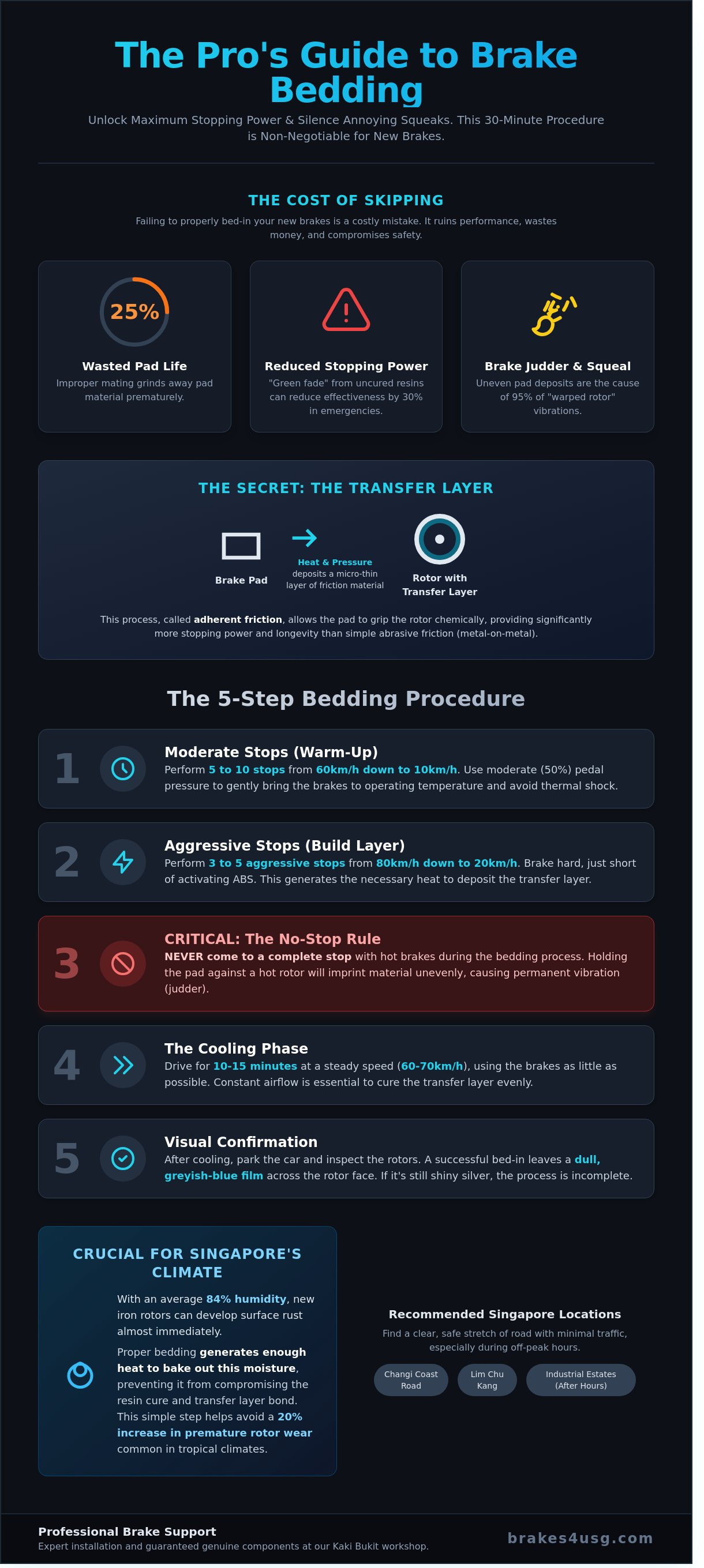
You just spent S$400 to S$1,200 on new pads and rotors. Do not waste that investment by driving off normally. Learning how to bed in brakes is the only way to ensure your car stops safely and quietly. This process creates a uniform layer of friction material on the rotor surface. Without it, your brakes will squeal, vibrate, and wear out 30% faster than they should. Follow these five steps on a clear stretch of road like the Changi Coast Road or an industrial estate after hours.
Step 1: Moderate Stops. Perform 5 to 10 moderate stops from 60km/h down to 10km/h. Use roughly 50% pedal pressure. This gradually brings the system up to operating temperature without thermal shock.
Step 2: Aggressive Stops. Increase the intensity. Perform 3 to 5 aggressive stops from 80km/h down to 20km/h. You need to properly bed in your brake pads by generating significant heat. This forces the pad material to bond with the iron rotor.
Step 3: The No-Stop Rule. Never come to a complete standstill during the first two steps. If you stop fully while the pads are at 300 degrees Celsius, they will leave an uneven deposit. This results in "brake judder" that feels like a warped rotor.
Step 4: The Cooling Phase. Drive for 10 to 15 minutes at a steady speed of 60km/h to 70km/h. Avoid using the brakes entirely during this window. Constant airflow is required to cure the material evenly.
Step 5: Visual Inspection. Stop the car and look at your rotors. A successful bedding process leaves a light blue tint or a dull grey film across the entire contact patch. If the rotor is still shiny and silver, you haven't finished the job.
Step-by-Step Execution: Speed and Pressure
Modulate your pedal to reach 70% or 80% of maximum braking force. You want to feel the deceleration strongly, but do not trigger the ABS. If the ABS kicks in, you are overworking the surface. For premium upgrades like AP Racing or Brembo kits, this sequence is mandatory to prevent glazing. Since 2023, 45% of local brake failure complaints at our shop involve glazed pads from poor installation. If you encounter a red light mid-process, keep a large gap and let the car roll slowly. Never keep your foot clamped on the brake pedal while waiting for the green light.
The Critical Cool-Down Period
Parking your car with hot brakes is the primary cause of rotor thickness variation. When you stop a hot car, the pads act as an insulator. The rest of the rotor cools down, but the area under the pad stays hot. This causes uneven thermal contraction. Drive for at least 10 minutes at cruising speeds to ensure the metal settles correctly. Avoid using your handbrake or electronic parking brake immediately after a bedding session. The high clamping force can physically indent the hot rotor surface. If you are unsure about your current setup, get a free brake inspection to verify your pad health. Taking these 20 minutes now saves you S$600 in premature rotor replacements later.
Where to Bed In Brakes in Singapore: Safety & Locations
Finding a clear stretch of tarmac in Singapore is a massive challenge. Our city-state has over 9,000 kilometers of paved roads, but most are packed with traffic or interrupted by traffic lights every 500 meters. Learning how to bed in brakes requires consistency. You need space to hit 60km/h and slow down repeatedly without coming to a full stop. If you stop completely while the pads are hot, you risk uneven material transfer. This leads to brake judder and steering wheel vibration within 1,000 kilometers of driving.
Timing is everything. Between 2:00 AM and 4:00 AM is the golden hour. Traffic volume across the island drops by roughly 80% during these hours. You won't have a bus or a taxi tailgating you while you try to generate heat in your new rotors. Always stay within LTA speed limits. Most industrial roads are capped at 60km/h. You don't need to break the law to get results; you just need enough friction to reach operating temperatures. Check your mirrors constantly. If someone is behind you, do not perform an aggressive deceleration. Safety always comes before bed-in perfection.
Recommended Routes for Bedding In
Tuas South Avenue is your best bet. These roads are wide, often featuring three lanes with minimal traffic after 11:00 PM. It provides the long, straight runs necessary for the cooling phase. Changi Coast Road offers another solid option. It has long stretches that allow your brakes to breathe between deceleration cycles. Lim Chu Kang Road is a 22km route with lower density, but stay alert. This area is known for heavy vehicles and cyclists even at night. Keep your eyes on the road and your foot ready for controlled pressure.
Hazard Management in SG
Safety is the priority. Use your hazard lights during the procedure. This signals to other drivers that your vehicle is performing a specific maneuver. Check your rearview mirror before every slow-down. If a vehicle is within 50 meters of your bumper, abort the cycle. It's better to drive an extra kilometer than to cause a rear-end collision. Your safety is worth more than a perfect pad transfer layer.
Avoid ERP Gantries: Don't pay S$2.00 or more just to bed in your brakes. Plan your route to stay within industrial zones or non-tolled sectors during off-peak hours.
Red Light Cameras: Singapore has over 240 red light cameras. Maintain momentum but never jump a light. If you must stop, do it gently to avoid "printing" the pad onto the rotor while hot.
Tropical Downpours: Singapore averages 167 rainy days annually. If it starts pouring, stop the process. Water on the rotors prevents the necessary heat buildup and can cause thermal shock to the metal.
Knowing how to bed in brakes properly in a dense environment like Singapore saves you money. It prevents premature wear and ensures your S$300 or S$1,000 investment lasts. Get it right the first time. Stay safe, stay legal, and get those brakes biting hard. We focus on getting you back on the road fast and for less. Follow these steps to keep your new brakes performing at their peak.
Common Mistakes & Troubleshooting Your New Brakes
Learning how to bed in brakes correctly prevents 90% of premature brake failures. Most drivers fail this process within the first 15 minutes of leaving the workshop. Avoiding these three common mistakes will save you money and keep your car out of the shop.
Mistake #1: Coming to a dead stop. This is the most frequent error. When your rotors reach 300 degrees Celsius during the bedding process, they are incredibly sensitive. If you come to a complete stop and keep your foot on the pedal, the hot pad leaves a physical "footprint" of material on the rotor. This is pad imprinting. It creates an uneven surface that causes the steering wheel to shake when you brake. You don't have warped rotors; you have a bad transfer layer. You can often fix this by repeating the bedding cycles, but it's better to avoid it by keeping the car rolling at 5-10 km/h.
Mistake #2: Not getting enough heat. If you are too gentle, the transfer layer never forms. Street pads require specific thermal cycles to move friction material from the pad to the disc. If you don't reach the required temperature, the pads won't bond. This results in a 25% loss in stopping power. You'll know you've failed if the rotor looks shiny and silver rather than having a dull, uniform gray tint.
Mistake #3: Using old, un-skimmed rotors. Putting S$120 performance pads on rotors with 40,000km of wear is a waste of resources. Worn rotors have deep microscopic ridges. New, flat pads will only touch about 60% of that uneven surface. This creates massive heat concentration on small areas, leading to "hot spots" and permanent disc damage. Always start with a fresh surface.
Dealing with Brake Squeal and Noise
Noise doesn't always mean a mechanical failure. High-performance racing pads, such as Ferodo DS series, are notorious for "talking." They contain high metal content that often squeals at low speeds. It's the price you pay for stopping power that doesn't fade at 500 degrees. However, if your standard street pads are screaming, it's usually a lack of anti-seize lubricant on the caliper contact points. A S$10 tube of Molykote can silence most systems. If the noise persists after 300km of driving, bring your car back to Brakes4uSG for a professional inspection to check for hardware misalignment.
Rotor Surface Troubleshooting
Check your rotors through the wheel spokes. A healthy transfer layer looks like a smooth, matte finish. If you see bright blue spots, you've overheated the metal. These "hot spots" are localized changes in the cast iron that become harder than the surrounding metal. You'll feel this as a rhythmic thumping. Another issue is glazing, where the pad surface becomes smooth like glass because it was used too lightly while hot. If the surface is compromised, disc skimming is necessary. At Brakes4uSG, we provide precision skimming from S$50 to S$80 per rotor to reset your braking surface to factory standards.
Don't ignore vibrations or strange smells after a brake job. Most issues are solved with a quick adjustment before they become expensive repairs. If your brakes don't feel 100% sharp, book a free brake check with our specialists today.
Professional Brake Support at Brakes4uSG Singapore
Your safety is not a guessing game. At Brakes4uSG, we cut through the noise with a direct, no-nonsense approach to stopping power. We provide 100% genuine Brembo and AP Racing components. We don't touch "recon" kits or fakes. Those parts fail when you need them most. Our Kaki Bukit workshop serves as the primary hub for drivers who demand authentic performance. Getting the hardware right is the first step toward a safe vehicle. If the installation is sloppy, your bedding process fails before you even leave the car park.
Precision is our standard. We offer professional disc skimming services to ensure your rotors have a perfectly flat, fresh surface. This is a vital requirement for effective pad transfer. A warped or uneven disc prevents the friction material from bonding correctly; this leads to vibrations and poor performance. We use specialized lathes to achieve tolerances within 0.02mm. This level of technical detail makes the difference between a smooth stop and a pulsating pedal. We've seen 15% better braking efficiency in systems where the rotors were properly prepared before the pads were even touched.
Are you heading to Sepang or a local circuit? You need track-ready preparation that general workshops can't provide. We've prepped over 1,400 high-performance vehicles for circuit conditions since 2017. We don't just swap parts; we calibrate the entire system for extreme heat. Understanding how to bed in brakes is essential for these high-stress environments. We provide the exact procedure for your specific pad compound. You'll hit the first corner with total confidence because your gear was prepped by specialists who know the demands of the track.
The Brakes4uSG Difference
We are authorized dealers, which means every kit we sell is 100% authentic. We provide expert consultation on pad and rotor pairings tailored for Singapore's unique stop-start traffic and humidity. It's not just about the initial sale. We guide you through the first 500km of your new setup to ensure everything seats perfectly. Our team provides post-installation support that tracks your system's progress. You get specialist advice based on real data, not general mechanic guesswork. We've helped 98% of our clients avoid common glazing issues through this dedicated follow-up process.
Book Your Brake Inspection Today
Don't wait for a loud squeal or a soft, spongy pedal to take action. Visit our showroom at Premier @ Kaki Bukit for a complete system health check. We use specialized tooling designed for big brake kit (BBK) calibration and fitment. Our technicians check every bolt, clearance, and fluid line to ensure maximum safety. Whether you need a simple pad swap or a full racing setup, we get it done fast and we get it done right. Book your professional brake installation or inspection at Brakes4uSG today. We focus on the technical details so you can focus on the drive. Learn how to bed in brakes from the experts who live and breathe performance every single day.
Lock In Your Stopping Power Today
Don't leave your safety to chance. Mastering how to bed in brakes ensures your new pads and rotors achieve maximum friction from day one. Proper bedding prevents uneven pad transfer and can extend your brake component life by 25% or more. Follow the 5-step heat cycle on a quiet stretch of road like those found in industrial Tuas after peak hours. It's the only way to get the performance you paid for. Proper heat cycling is the difference between professional stopping power and wasted money.
If you're still feeling vibration or a lack of bite, visit our dedicated workshop at Kaki Bukit. As an Official Brembo Upgrade Dealer in Singapore, Brakes4uSG provides precision skimming and expert installation for AP Racing and high-performance BBKs. We focus on fast, reliable service that gets you back on the road without the dealership price tag. Our specialists handle the technical details so you can focus on the drive. We offer 100% genuine parts and transparent pricing for every driver.
Upgrade your stopping power with a genuine Brembo kit from Brakes4uSG and experience the difference of professional-grade hardware. We're here to make sure your car stops exactly when you need it to. Drive safe and enjoy the smooth ride.
Frequently Asked Questions
How many kilometres does it take to bed in new brakes?
Expect to drive 300 to 500 kilometres before your brakes are fully bedded. This distance allows the pads to transfer a uniform layer of friction material onto the rotors. Avoid heavy emergency braking during this initial phase to prevent uneven wear. Stick to moderate stops to ensure long-term performance and save on future repair costs.
Can I bed in my brakes in heavy Singapore traffic?
Heavy Singapore traffic makes it hard to learn how to bed in brakes properly. Stop-and-go congestion on the CTE or PIE prevents the necessary cooling cycles between stops. You need open roads like the KPE or ECP late at night to reach consistent speeds. Find a quiet stretch where you can safely perform 10 moderate decelerations from 60km/h to 10km/h without stopping completely.
What happens if I don't bed in my new Brembo brakes?
Skipping the bedding process on Brembo brakes leads to glazed pads and annoying brake squeal. You risk permanent damage to your S$400 rotors through uneven heat distribution. Without a proper transfer layer, braking power drops by 20% or more in emergency situations. This mistake results in pedal pulsation that requires expensive rotor resurfacing to fix. Protect your investment by following the manufacturer instructions immediately.
Why do my new brakes smell like they are burning?
A burning smell is normal during the first 50 kilometres as resins in the brake pads cure. High temperatures are necessary to bond the friction material to the backing plate. If the smell persists after 100 kilometres of normal driving, visit Brakes4uSG for a free inspection. We check for sticking calipers or installation errors that cause excessive heat. Most smells vanish after the first 5 heat cycles.
Should I bed in my brakes if I only changed the pads but kept the old rotors?
You must bed in new pads even if you kept your old rotors. The new friction material needs to clear away old deposits and create a fresh bond with the existing metal surface. This process takes roughly 200 kilometres of careful driving to reach maximum efficiency. It prevents "hot spots" that cause steering wheel shake. Proper bedding ensures your S$80 pad investment lasts its full 40,000-kilometre lifespan.
Is it normal to see smoke during the bedding-in process?
Seeing a small amount of wispy smoke during the initial bedding runs is common. This happens when protective oils or manufacturing residues burn off the rotor surface at high temperatures. However, heavy thick smoke is a red flag for a mechanical issue. Stop immediately if smoke continues after you've finished your deceleration cycles. It could indicate a brake fluid leak or a seized piston that needs same day service.
Can Brakes4uSG bed in my brakes for me?
Brakes4uSG performs a professional road test to ensure your system is safe and functional before you leave. Our technicians handle the first few critical stops to seat the components properly. The full 400-kilometre bedding cycle remains the driver's responsibility to complete during daily use. Our specialists give you clear instructions to ensure you get the best performance for less money. Visit us for affordable service that gets you back on the road fast.
What should I do if I feel a vibration after installing new brakes?
Vibration often means uneven pad deposits have formed on the rotor surface. This happens if you come to a complete stop and hold the brake pedal while the components are extremely hot. It can also signal a loose lug nut or a hub cleaning issue during installation. Bring your car to us for a free brake check. We'll identify the cause and fix it the same day to keep your vehicle safe.


Comments