


7 Critical Signs Your Car Brakes are Failing in Singapore (2026 Guide)
- Darren Phang
- Mar 25
- 11 min read

What if that faint squeak you hear while crawling along the PIE isn't just a nuisance, but a warning that your vehicle won't stop in time for the next sudden jam? You already know that Singapore’s stop-start traffic is brutal on your rotors and pads. It's stressful enough without worrying if your brakes will hold up or if a workshop will hit you with a S$1,200 bill for "hidden" repairs. You want to stay safe without getting ripped off by overpriced dealership markups.
This 2026 guide helps you spot the critical signs your car brakes are failing before you're stuck in an emergency. We'll show you exactly what to look for. You'll identify the problem before you even step into a workshop. You'll gain the facts needed to avoid confusing jargon and save on high quality parts. We are going to cover the seven red flags that mean your car needs an immediate, affordable inspection to keep you moving safely on the AYE. Stop the worry. Save your money. Get back on the road fast.
Key Takeaways
Stop-start Singapore traffic wears pads 3x faster than highway driving. Learn how to spot early degradation before you lose total stopping power.
Identify the 7 most critical signs your car brakes are failing, from high-pitched squealing to dangerous metal-on-metal grinding.
Master a 5-minute DIY inspection you can do at home. Check your pad thickness and rotor health through your wheel spokes in seconds.
Protect your safety and your wallet. Discover why 100% genuine Brembo and AP Racing components are the only choice over risky "recon" kits.
Table of Contents Why Ignoring Brake Warning Signs is Dangerous in Singapore 7 Signs Your Car Brakes are Failing: The Checklist Performance Degradation vs. Total Failure The 5-Minute DIY Brake Check for Singapore Drivers Expert Brake Repair in Singapore: The Brakes4uSG Difference
Why Ignoring Brake Warning Signs is Dangerous in Singapore
Ignoring the early signs your car brakes are failing is a fast track to a massive repair bill or a collision on the PIE. Brake failure rarely happens as a sudden, total loss of power. It starts as a slow degradation of your stopping distance. In Singapore, our constant stop-start traffic puts 300% more stress on your pads and rotors than standard highway driving. Every red light and traffic jam at the CTE tunnel wears your system down faster than you think. Catching wear early saves you serious money. Replacing worn pads is an affordable fix. Waiting until they grind into your rotors can triple your repair costs in S$.
Our 32°C average daily temperature is another silent enemy. High ambient heat accelerates the wear of rubber seals and brake lines. These components become brittle and crack over time. If you feel any change in your pedal, don't wait. We provide a no-nonsense approach to safety. Get it fixed now before a minor squeak becomes a major safety hazard.
The Reality of Brake Wear in Tropical Climates
Singapore's 80% average humidity levels directly impact your car's hydraulic system. Brake fluid is hygroscopic. This means it actively absorbs moisture from the tropical air. When water gets into the lines, it lowers the boiling point of the fluid. This leads to "spongy" brakes that feel soft when you press down. To get a better grasp of the physics involved, you can learn more about how car brakes work and why fluid integrity is vital. We define brake failure as any deviation from your vehicle manufacturer’s original stopping distances.
Safety Risks on the PIE and AYE
Driving on the PIE or AYE requires 100% confidence in your gear. Sudden afternoon downpours turn our expressways into skid pans in seconds. If your signs your car brakes are failing include a slight pull to one side or a longer stopping distance, you're at risk. "Just enough" braking power isn't enough for an emergency avoidance maneuver at 90km/h. A car with 20% brake degradation can take an extra 10 meters to stop in the rain. That distance is the difference between a close call and a multi-car pileup. Don't take the risk with your NCD or your life. Book a professional car brake check today to stay safe on the road.
7 Signs Your Car Brakes are Failing: The Checklist
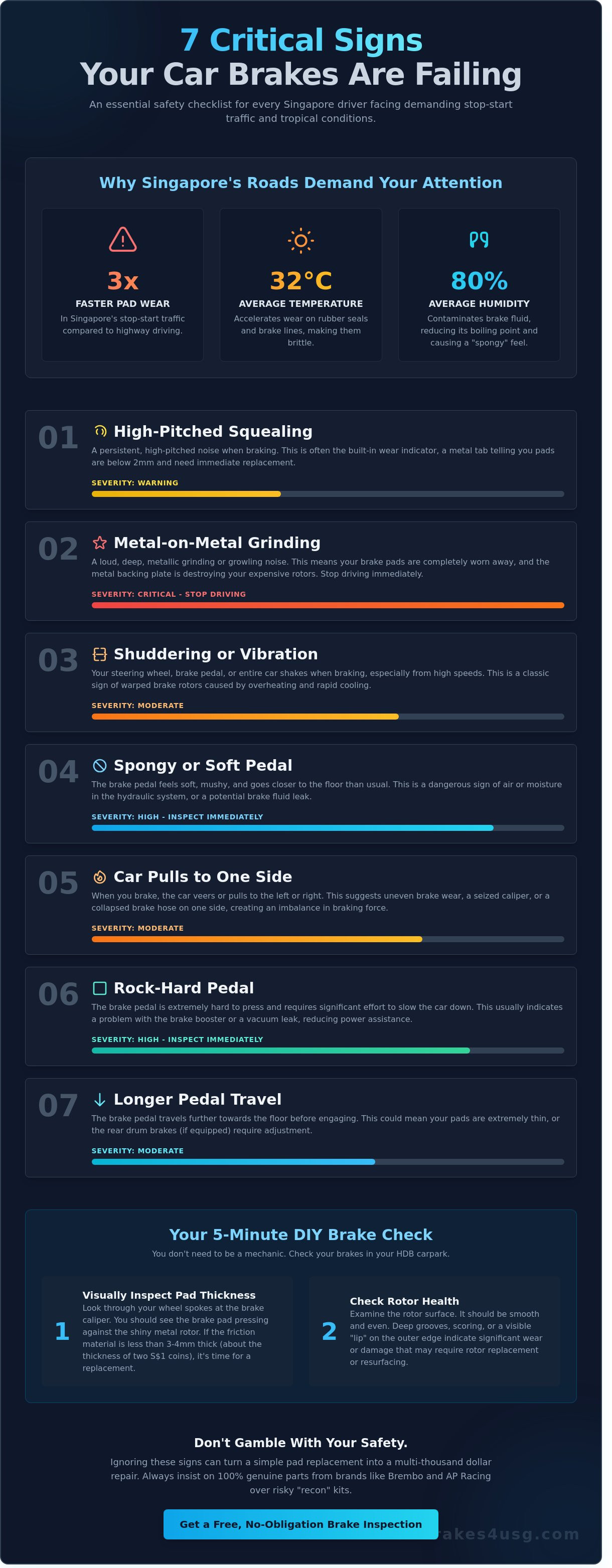
Don't wait for a total failure to realize your stoppers are shot. Your car gives clear warnings long before the pedal hits the floor. Most drivers in Singapore ignore these signals until an LTA inspection or a close call on the PIE. Recognizing the signs your car brakes are failing saves you from S$1,000+ repair bills and dangerous road situations. Use this checklist to stay safe.
Listening for Trouble: Squeaks vs. Grinds
High-pitched squealing isn't just an annoyance. It's a built-in safety feature. Most modern pads include a small metal tab called a wear indicator. When your friction material hits the 2mm thickness mark, this tab scrapes the rotor. It's a "change me now" signal. If you hear a "cold morning squeak" that vanishes after two blocks, it's likely just surface moisture. If it persists, your pads are thin.
Grinding is a different beast. This deep, metallic sound means your pads are completely gone. You're now pressing metal backing plates directly against your rotors. This causes immediate damage to S$150 to S$400 rotors. Stop driving and visit a workshop immediately. Note that high-performance pads from brands like Ferodo often produce more noise naturally due to their high metallic content. However, for a standard daily driver, silence is the goal. Get a free brake inspection if the noise doesn't stop.
Feeling the Feedback: Shudders and Sponginess
If your steering wheel vibrates or shudders when braking at 80km/h, your rotors are likely warped. This is common in Singapore's 33°C heat and sudden tropical downpours. Rapid cooling of hot metal causes distortion. These uneven surfaces prevent the pads from gripping properly, which increases your stopping distance by 15% or more.
A soft or "spongy" pedal is a red alert for your hydraulic system. This usually means air or moisture has contaminated your brake fluid. Since air compresses and fluid doesn't, you lose the firm pressure needed to stop. To stay safe, it helps to understand how the braking system works and why maintaining hydraulic integrity is vital. Other physical signs your car brakes are failing include:
The car pulling to one side: This indicates a seized caliper or a collapsed brake hose.
A rock-hard pedal: Usually a sign of a failing brake booster or a vacuum leak.
Longer pedal travel: Your pads are extremely thin or your rear drum adjusters are stuck.
We see these issues every day. Most can be fixed in under 90 minutes with our same-day service. Don't gamble with your safety on the CTE.
Performance Degradation vs. Total Failure
Brakes don't always quit instantly. Often, they fade slowly before they fail completely. Ignoring the early signs your car brakes are failing leads to expensive repairs or dangerous situations on the KPE. You need to know the difference between a system that's tired and one that's about to die. Performance degradation is a warning. Total failure is a catastrophe.
Understanding Brake Fade
Brake fade is the temporary loss of stopping power caused by extreme heat. It usually happens during heavy stop-start traffic or "spirited" driving sessions. Your pedal might feel firm, but the car just won't slow down. This is a sign your current system is overmatched for your driving habits. Check your rotors for a shiny, "glazed" appearance. This happens when pads overheat and leave a film on the metal. If your rotors look like a mirror, your braking efficiency has already dropped by 25% or more. Our specialists see this often on standard cars pushed too hard in the Singapore heat.
Fluid Health and Moisture Contamination
Singapore’s 80% average humidity is a silent killer for your car. Brake fluid is hygroscopic, meaning it absorbs moisture from the air. When water gets into the lines, the boiling point of the fluid drops significantly. Under hard braking, that water turns into steam. This creates a soft, spongy pedal that goes all the way to the floor. We recommend testing your fluid for moisture content every 12 months.
DOT 4 Fluid: The standard for 90% of cars in Singapore. It's reliable and affordable for daily commutes.
Racing Fluids: These handle higher temperatures but need more frequent changes because they absorb moisture faster.
Leak Signs: Check your reservoir monthly. A 15% drop in fluid levels or oily spots on your driveway indicates a leak that needs immediate attention.
If you've invested in an aftermarket Big Brake Kit (BBK), don't assume it's maintenance-free. These S$3,000 systems need professional servicing to stay effective. Squealing, clicking, or pedal vibration on a BBK suggests the calipers need a strip-down and clean. Don't wait for the pedal to hit the floor. We offer a free brake inspection to catch these issues early. We provide same day service to keep you safe and save you money. Stop by today for a quick check.
The 5-Minute DIY Brake Check for Singapore Drivers
Don't wait for a total system failure on the PIE. You can spot the signs your car brakes are failing right in your HDB carpark. It takes five minutes. It requires zero tools. Catching wear early saves you hundreds in repair costs. Most drivers ignore small changes until the metal starts grinding. Don't be that driver.
The Dashboard Check: Turn your key. If the ABS or Brake light stays on, your car's computer has detected a fault. This usually means a sensor failure or a drop in hydraulic pressure.
The Fluid Level: Pop your hood. Locate the translucent reservoir. The fluid must sit between the MIN and MAX lines. If it's at the MIN mark, your pads are likely thin. Low fluid is a red flag for leaks.
The Driveway Test: Drive at 20km/h in a quiet area. Press the pedal firmly. If the car pulls to one side, you have a seized caliper or uneven wear. Squealing noises during this test are clear signs your car brakes are failing and need expert attention.
How to Inspect Your Pads and Rotors
Grab a torchlight. Shine it through the spokes of your rims. Look for the brake pad pressed against the shiny metal disc. If the friction material looks thinner than 3mm, replace it immediately. Check the rotor surface for deep grooves or a "blueing" tint. Blue metal indicates the rotor hit temperatures over 300 degrees Celsius. This heat warps the disc and ruins stopping power. Look for a "lip" on the outer edge. If that lip is deeper than 1mm, your rotors are nearing the end of their life. We often use disc skimming to save your rotors if the wear is caught early, saving you the cost of a full replacement.
Navigating LTA Standards and Safety
Singapore LTA regulations are strict. Your service brake must hit at least 50% efficiency during your periodic inspection. Cheap replica kits or "recon" parts often fail these tests because they can't handle the heat of stop-start traffic in the CBD. Using uncertified parts risks an inspection failure and a S$30 re-test fee. Professional installation ensures your brake bias stays within the legal 15% variance. Don't gamble with your road tax renewal or your safety. Stick to components that meet or exceed OEM standards to ensure you pass every time.
Stop guessing about your safety. Get a free professional brake inspection from the specialists today.
Expert Brake Repair in Singapore: The Brakes4uSG Difference
Your safety isn't a negotiation. At Brakes4uSG, we refuse to sell "recon" or refurbished brake kits. These parts are often salvaged from scrapped vehicles or rebuilt with sub-par seals that leak under pressure. They fail when you need them most. We only stock 100% genuine Brembo and AP Racing components. Authentic hardware handles the extreme stop-and-go heat of Singapore traffic without fading. If you notice the signs your car brakes are failing, don't gamble with second-hand junk. We provide direct, honest solutions that keep you on the road.
Zero refurbished kits.
No fake "Brembo-style" covers or replicas.
100% genuine calipers, pads, and rotors.
Precision installation by dedicated specialists.
Genuine Parts vs. Dangerous Replicas
Don't fall for "too good to be true" deals on regional marketplaces. Cheap replicas often use low-grade cast iron instead of forged alloys. They crack during emergency stops. We source every component from authorized distributors to ensure 100% authenticity. Genuine parts offer 40% better heat dissipation than replicas. They last twice as long in local humidity. We verify every serial number for your peace of mind. Spotting the signs your car brakes are failing is the first step; fixing it with real parts is the only way to stay safe.
Visit Our Kaki Bukit Workshop
Our specialized facility at Premier @ Kaki Bukit is built for speed and precision. We don't just swap pads. We offer professional disc skimming to remove warps and restore a factory-smooth finish. This service saves you from buying new rotors prematurely. For track enthusiasts, we provide circuit-ready inspections. We check fluid boiling points and pad thickness to ensure you're ready for Sepang or the North-South Highway. Our inspections are fast, thorough, and unpretentious.
Stop worrying about your stopping power. Get a professional opinion at our Kaki Bukit hub. Book your professional brake check at Brakes4uSG today.
Stop Brake Problems Before They Stop You
Ignoring the signs your car brakes are failing is a gamble you won't win on Singapore roads. A small squeak today often turns into a S$2,000 major repair bill next month. Your safety depends on responsive stopping power; especially during sudden tropical downpours on the PIE or KPE. Don't let a soft pedal or grinding noise compromise your daily commute. Most brake issues are fixed quickly and affordably when caught early by a specialist.
Brakes4uSG is your dedicated specialist workshop located in Kaki Bukit. We are an Official Brembo Upgrade Dealer and use 100% genuine performance parts only. We don't do general repairs; we do brakes better and faster than anyone else. Our team provides transparent solutions without the dealership price tag or the long wait times. You get back on the road with total confidence and zero hidden fees. It's the smartest way to maintain your vehicle's safety without overpaying.
Get a Professional Brake Inspection at Brakes4uSG
Keep your car safe and your budget intact. We are ready to help you drive with peace of mind today.
Frequently Asked Questions
Is it safe to drive with squeaking brakes in Singapore?
No, driving with squeaking brakes isn't safe because the sound is a built-in warning that your pads are thin. Most brake pads in Singapore include a metal wear indicator that screeches once the material hits 2mm of thickness. Ignoring this noise leads to metal-on-metal contact. This destroys your rotors and increases your stopping distance by over 15 percent. Get a free inspection today.
How much does a typical brake repair cost in Singapore?
Brake pad replacement in Singapore typically costs between S$80 and S$180 per axle for Japanese cars. Continental models often range from S$150 to S$350. If you need new rotors, expect to pay an additional S$200 to S$500 per pair. We offer transparent pricing with no hidden fees. You get the best value and same day service at our workshop.
Why does my car shake when I step on the brakes at high speeds?
Shaking or vibrations usually indicate warped brake rotors. When rotors develop a thickness variation of just 0.02mm, you'll feel a pulse through the pedal or steering wheel. This often happens after heavy braking on the PIE or KPE where heat buildup is high. Warped rotors are common signs your car brakes are failing and require immediate resurfacing or replacement to regain control.
What is the difference between brake pad wear and rotor wear?
Brake pads are the sacrificial material that clamps onto the rotor to stop your car. They typically need replacement every 40,000 kilometers. Rotors are the heavy metal discs the pads grip. While pads wear down by design, rotors thin out or warp over time. A rotor below its minimum 20mm thickness discarded by the manufacturer is dangerous and must be replaced immediately to ensure safety.
Can I just top up my brake fluid if the light comes on?
You shouldn't just top up the fluid because a low level signals a serious problem. Your brake system is sealed, so a low light means your pads are 80 percent worn or there's a hydraulic leak. Adding fluid only hides the symptom. If your fluid drops below the "Min" line, bring it to us for a free check to prevent total brake failure and expensive damage.
How long do brake pads usually last in Singapore traffic?
Brake pads in Singapore typically last between 30,000 and 50,000 kilometers. Our heavy stop-start traffic in the CBD and constant braking on congested expressways like the CTE wears material faster than highway driving. If you drive a private hire vehicle or delivery van, you might need new pads every 25,000 kilometers. We recommend an inspection every 10,000 kilometers to stay safe.
What should I do if my brake pedal feels soft or sinks to the floor?
Stop driving immediately and call for a tow to our specialist center. A soft or spongy pedal is one of the most dangerous signs your car brakes are failing because it indicates air in the lines or a master cylinder leak. This condition can lead to a 100 percent loss of braking power without warning. Don't risk a collision on the ECP; get it fixed now.
Does Brakes4uSG provide disc skimming services?
Yes, we provide professional disc skimming services starting at S$60 per rotor. Skimming removes 0.1mm to 0.5mm of surface material to eliminate wobbles and restore a smooth braking surface. We complete most skimming jobs within 90 minutes. This is an affordable way to extend the life of your rotors without the high cost of a full replacement. Visit us for a quick turnaround.


Comments